
Director Product Planning and Marketing, Sharp Europe




With technology advancing at breakneck speed and the sheer volume of connected devices that now have access to a corporate network, it’s unsurprising that cyber threats are infiltrating more organisations.. It’s becoming increasingly challenging for businesses to have complete visibility on who is accessing their network. With this in mind, organisation should consider every endpoint and device a possible point of attack .
Despite this, organisations do not always cover all their bases – an oversight that can make cyber attacks, and subsequent loss of data and a damage reputation a real possibility. Take, for example, Office printers. These trusty office essentials are not traditionally thought of as a hackers’ Trojan horse. But in our experience working with small and medium enterprises across the UK, we see that they are underestimated as probable access points for bad actors.





This was reflected in our recent Europe-wide research on almost 6,000 IT Managers and decision makers. We wanted to understand the IT investment priorities and security capabilities of SMEs and found that in the UK, almost one in five (16%) businesses had been impacted by a printer security breach. Just 3% worried about the security risk of printers and a third (33%) had no IT security measures in place at all to cover printers.
While this may not sound all that surprising, it’s an alarming sentiment, because printers have evolvedjust as other workplace tech has, in order to meet the needs of a modern office. Today, multi-functional printers (MFPs) are epicentres of connectivity. MFPs are connected to the business’s network, employees’ individual devices, and in some cases, even to the employees who work from home. In short, this means they are a highly vulnerable and largely overlooked gateway.
So how can organisations protect themselves against these threats? As with all things security, it boils down to people, processes and technology.
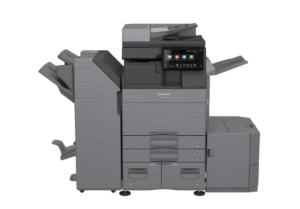 An organisation’s employees are its first line of defence. As such, it’s important to establish protocols for handling sensitive documents and ensure employees understand them. This can be as simple as securely disposing printed materials and not leaving them unattended in the tray. Controlling access to MFPs via user authentication through PINs, smart cards, or biometric systems can increase visibility of users on your network. The greater the visibility, the more likely that potential threats can be identified and neutralised.
Implementing processes for the secure management and disposal of printed documents is important, but in our increasingly digital age, so too is managing the document lifecycle. This includes the capturing of information, whether scanning hard-copy documents, monitoring email or creating and saving documents from an application; storage and preservation of physical and digital documents; and of course, enabling documents to be securely shared both internally and externally.
MFPs today also offer in-built cyber security to add a layer of protection for your organisation. At Sharp we recently introduced Bitdefender antimalware technology series. At an absolute minimum, MFPs must be factored into an organisation’s overall IT security posture and considered a vulnerable endpoint.
The more advanced and integrated MFPs become the greater the risk to confidential information. All organisations have a responsibility to protect the data they hold about their customers and employees. And with increasingly stringent regulatory and compliance requirements, such as GDPR – and potentially, other requirements on the horizon with the recent change in government – print security can no longer be overlooked.
For further information, please visit www.sharp.co.uk