
Michelle Ryder caught up with Ruth Patterson, Managing Director, HP Inc. UK&I, to discuss HP’s channel-first strategy, the company’s future of work agenda and what the latest Work Relationship Index study reveals about the state of the UK workforce.


 Ruth Patterson is a year into her role as Managing Director for HP UK&I. Speaking about her priorities and focus areas over the past twelve months, she said the channel has and will remain front and centre. “We are a channel-first company and my priority has been to really focus on, invest in and develop channel relationships and partnerships, and continue the momentum that we have as strong foundations.”
Patterson also said that HP’s future of work strategy, which is built around enabling seamless, secure and highly productive hybrid work through AI-driven devices, cloud platforms and employee experience-focused solutions, has not changed and will continue to evolve and grow.





“Our goal is to help channel partners be successful and provide them with the solutions they need to deliver the right outcomes for their customers. That includes the breadth and depth of HP’s hardware portfolio as well as our broader services and software offerings.”
The Work Relationship Index
HP has led a global study on the world’s relationship with work across three audience groups, in 14 countries for the past three years. In the UK, the 2025 Work Relationship Index (WRI) study found that work is not working; for the first time, UK knowledge workers’ relationship with work is most likely to be critical.
Among the key findings was the fact that just 15% of knowledge workers report a healthy relationship with work, one of the lowest scores in the survey and an 11 percentage point decline year on year.
In addition, business leaders saw a sharp 15 point drop, reflecting a tough business environment. Falling scores for fulfilment, leadership and people- centricity show a workforce seeking purpose and feeling less cared for. Loyalty to companies fell for knowledge workers and business leaders, although IT decision-makers appear to be becoming more loyal.
Changing work habits
Two-thirds of UK workers have experienced change this year, particularly cost cutting and changes to hybrid working patterns and 61% feel that demands and expectations have increased, the highest among developed markets.
Despite high negativity around the cost of living, global politics, the UK’s prospects and its job market, 33% of workers reported company growth last year, compared with a 28% developed market average.
Tech and AI
The study found that technology is broadly seen as a positive enabler, with 76% believing it has enhanced their work-life balance.
The report highlighted an opportunity to upskill and democratise access to technology for UK knowledge workers, particularly older generations, which fell behind in 2025. AI usage reached 76% in the UK, with 32% using AI daily for a wide range of tasks.
Gen Z is also reshaping expectations; three in four would give up salary for increased flexibility and autonomy, and 52% have a side hustle, earning income alongside their regular job.
For Patterson, the findings reinforce why HP’s future of work strategy matters. “A big part of people’s relationship with work is technology. Do they have the tools and equipment to perform their role? Do they have the support from a software perspective? What is the total work experience? That’s where the future of work comes into play,” she explained.
“Our strategy is to work closely with CIOs to equip employees with the tools they need to thrive, partnering with the channel to deliver end-to-end solutions that drive the future of work and support long-term success for customers.”
One HP proposition
HP offers what Patterson describes as the broadest portfolio of solutions, supported by leading edge software such as its WXP platform. WXP brings together insights that help CIOs make proactive decisions, whether that’s identifying performance issues before employees feel frustrated, or understanding which roles require high performance workstations versus entry level devices.
Notably, HP’s study found that businesses who invest in tools and bring AI into daily life for their workforce are reaping the rewards. 40% of those with a healthy work relationship use work-provided AI tools daily.
 This is where HP’s One HP proposition comes into play. “We are the one company out there that offers a breadth and depth of solutions across the total portfolio – from PCs and print to peripherals and collaboration tools through Poly. Whether a user is on the road with a Poly headset or in a meeting room equipped with Poly conferencing solutions, the aim is to ensure everyone feels equally present and able to contribute,” she said.
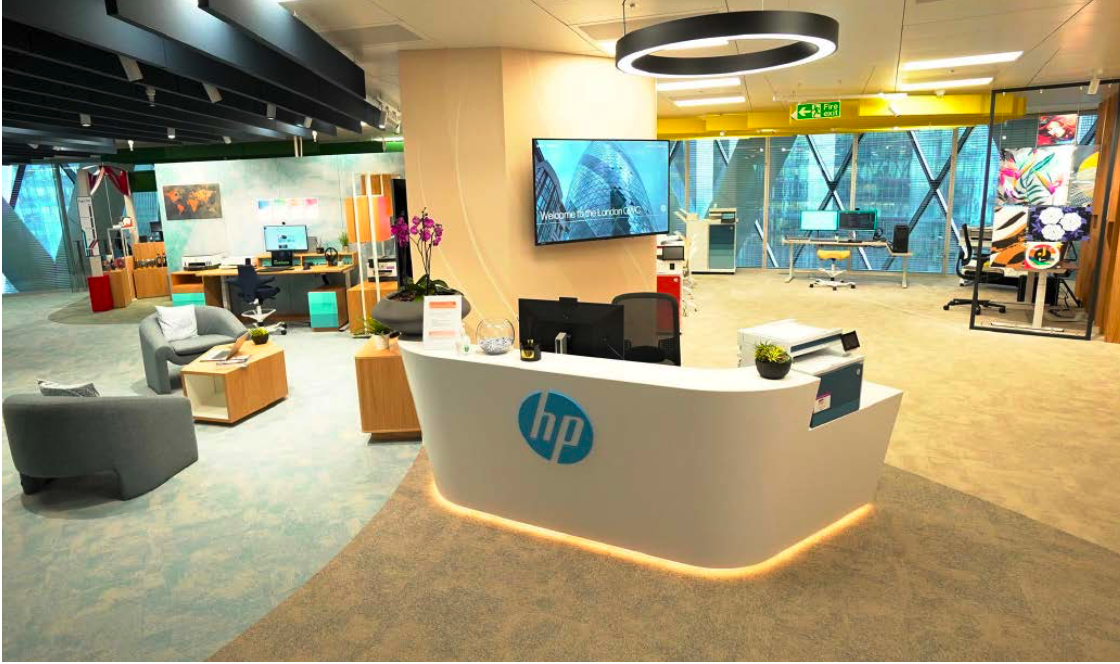
One key focus area is working with channel partners to bring this to life via the HP Welcome Centre. Based at the Gherkin in London, HP’s flagship customer experience space offers immersive experiences and showcases HP’s solutions, particularly in the context of hybrid work. “The Welcome Centre is designed to bring use cases to life, allowing partners to ‘walk in the shoes’ of the customers they serve,” Patterson explained.
Amplify partner programme
That same mind-set informs HP’s work with partners through its Amplify partner programme sharing best practice, exploring new opportunities and ensuring partners have access to the expertise they need.
The Amplify partner programme continues to grow and evolve particularly around sustainability, broader social values, security and AI. Amplify includes a comprehensive AI training component for partners. Strategic relationships with partners such as Nvidia play a key role in delivering the right education.
HP supplements this with subject matter experts, CIO forums and roundtables, including print-focused sessions held in its UK and Ireland security labs in Cambridge and Bristol, which serve as HP’s worldwide security hub.
With AI, the rapid growth of data and increasing security and sovereignty concerns, HP is investing heavily in edge compute. “With edge compute, you can keep large language models local, avoiding the security risks of sending data to the cloud. And from a sustainability perspective, we simply don’t have unlimited energy and water to support the rapid growth of datacentres. It’s a huge area that from an environmental perspective, we need to be very aware of,” Patterson explained.
By continuing to enhance partner support, and doubling down on innovation, HP intends to lead the way in shaping a more productive, sustainable and human-centred future of work.

