
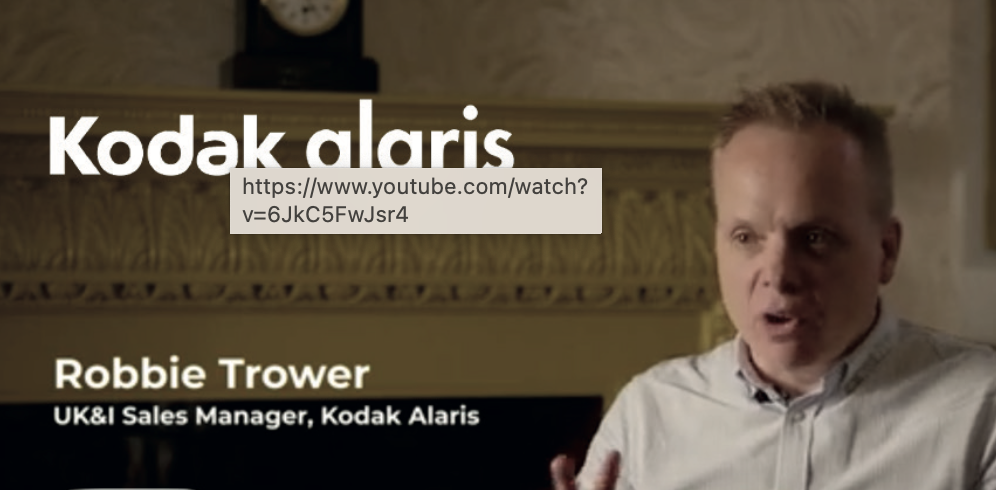
Michelle Ryder spoke with Robbie Trower, Sales Manager UK & Ireland at Kodak Alaris to discuss the company’s heritage in document capture and its new solutions-led strategy





Michelle Ryder (MR): Scanners from Kodak Alaris are renowned for reliability and image quality. As a manufacturer of dedicated document scanners, where do you see Kodak Alaris positioned within the capture industry?
Robbie Trower (RT): One of the main reasons I joined Kodak Alaris, four and a half years ago was because it always had such a broad portfolio compared to everybody else – the broadest range of hardware options, but also on the capture software side as well.





Nobody else could offer that complete capture suite and meet a customer’s requirement for document scanners, capture software, or both, for many years Kodak Alaris has been one of the only companies that can provide all of those things in one go. I think that’s always been one of the company’s strengths, and what makes it unique in the industry.
If you look at the top document scanner brands or manufacturers, we’re the only one that is actually a document scanner company, wholly focused on document scanners and on capture.
Our competitors have got another background, or they’ve been absorbed into another business. There are of course print OEMs that have scanners as part of their range, but its not necessarily their core focus like it is with us.
MR: You recently created a global business solutions organisation and announced plans to transition to a software solution-led business. How have you introduced this shift in go-to- market strategy to channel partners, and how is it being received, particularly by traditional MFP resellers?
RT: Kodak Alaris has had a software strategy for over a decade, we’ve been offering capture solutions for well over 10 years and we are very successful in the marketplace. Many of our partners were already aware that we had software strengths and that we weren’t just a scanner company, so we weren’t having to push against closed doors. Expanding our software range and reach has been received very well by the channel.
There are a lot of managed print and traditional MFP resellers and dealers that have sold dedicated scanners, but not seen it as the size of an opportunity that they now see it as. Going back to the point I made about Kodak Alaris being a document capture specialist, we complement the offering other vendors have – our printer OEM partners and their channel work with us rather than a competitive brand that also provides scanners.
There is some education involved in helping channel partners identify scanning and capture opportunities, as well as when software is needed, and as we work together, asking the right questions is helping create new revenue as well as helping them to get closer to their customers and add more value.
MR: Accelerating growth within your adjacent intelligent document processing (IDP) offerings is a key business priority. Can you explain more about your IDP offering?
RT: Capture software from Kodak Alaris has been used for over a decade to manage batches of documents, for OCR and reading barcodes for example, particularly within high volume end-user environments such as local and central government agencies and in bureaus. But the next step up from that is more complex capture or what is referred to as IDP – intelligent document processing.
IDP starts with the system looking at each individual document or batch of documents, determining what each document is and classifying it. Each different type of document has a different workflow – for example within accounts payable, invoices go in one direction, correspondence go in another direction, application forms, go over there, etc, etc. So, the first step is really managing and classifying documents into those types. Once that’s been done, for each document type, the system extracts the right information from the right document, and if needed validates it against databases to ensure it’s captured everything correctly, before moving on to the next system.
So, in theory, every single document coming into an organisation be that paper or digital via emails will be captured and processed so it ends up in the right system, whether that’s an ERP system, a CRM system, HR database, whatever it might be. The point is, is that it doesn’t really matter what the document type is or where it needs to go. IDP is that hub that sits between the documents coming in and where they need to live
MR: DX strategies have accelerated at pace, which is creating incremental opportunities within the document capture market. How can you help or how do you help your partners address and resolve their customers’ pain points around enabling successful digital transformation?
RT: We have a number of partners who are already well established in enabling their customer’s successful digital transformation, and how we support new and existing partners largely depends on where they are on the journey of talking about DX to their customers.
We have an onboarding process for all partners looking to embrace IDP, ensuring they understand how the product works, the commercial proposition and how it is licenced. That’s a key thing for our partners, they need to know: ‘If I’m going to be selling this, what is it and how do I package it up?’
We support and provide training around what key things they should be looking for within their customer base. So for example, what questions they need to ask around workflow within a certain document-intensive department such as the mailroom or accounts payable. It also depends on the vertical, if it’s a manufacturing or a logistics company, we know where the sweet spots are when it comes to getting products produced and shipped for example. For a law firm, it’s all about incoming mail, and getting those documents classified and indexed and in front of the fee earner so they can do their job.
So, what we say to partners that want to go down this route is that we’ve got a skilled sales team at Kodak Alaris, and we’ll do a lot of that upfront work with them as part of the training. We’ll support during those first meetings with customers to talk about document capture and IDP and we will also do the first few installs with them. We help with identifying opportunities, sales engagement, the sales process itself, through to project management and delivering the installations.
MR: The channel is obviously a key integral part of the business, what’s the channel strategy moving forward?
RT: Absolutely, our channel partners are very much a key part of our business. We have very strong and close relationships with our partners, as I mentioned earlier. Looking at revenue over the past three to four years, we’ve seen a significant increase in software revenue. So, we’re clearly making the right sort of noises and doing the right things to support our partners to deliver that growth.
We have been proactive in promoting our software solutions but if we look at our hardware portfolio, we’re also supporting on that side too. We have some very keen promotions on at the moment that will run through March 31, these are designed to help our partners secure new business. Promotions are always well received and at the moment we are focusing
on two key models in both the A4 and A3 ranges.
Our strategy is very much focused on getting the message out there and providing as much support as we can to our partners. We recognise that communication and education are key. So, to support and enable partners to increase software sales, we recently ran a series of webinars centred on KODAK Info Input Solution, our IDP offering and its capabilities and these were all well attended. We also held some partner days, in our new HQ in Hemel Hempstead and in Milton Keynes, which provided us with the opportunity to engage with our partners face-to-face. We only spent a very small part of those days talking about our scanners, the focus was more on: how do we support you from a marketing perspective and how can we reward you for doing business with us?
Moving forward we will continue to create awareness of our wider offering, support our partners with the right pricing and commercial offering and the right sort of education, making sure our communications are as up to date and regular as possible.
To watch the full interview please visit https://www.youtube.com/ watch?v=6JkC5FwJsr4
