
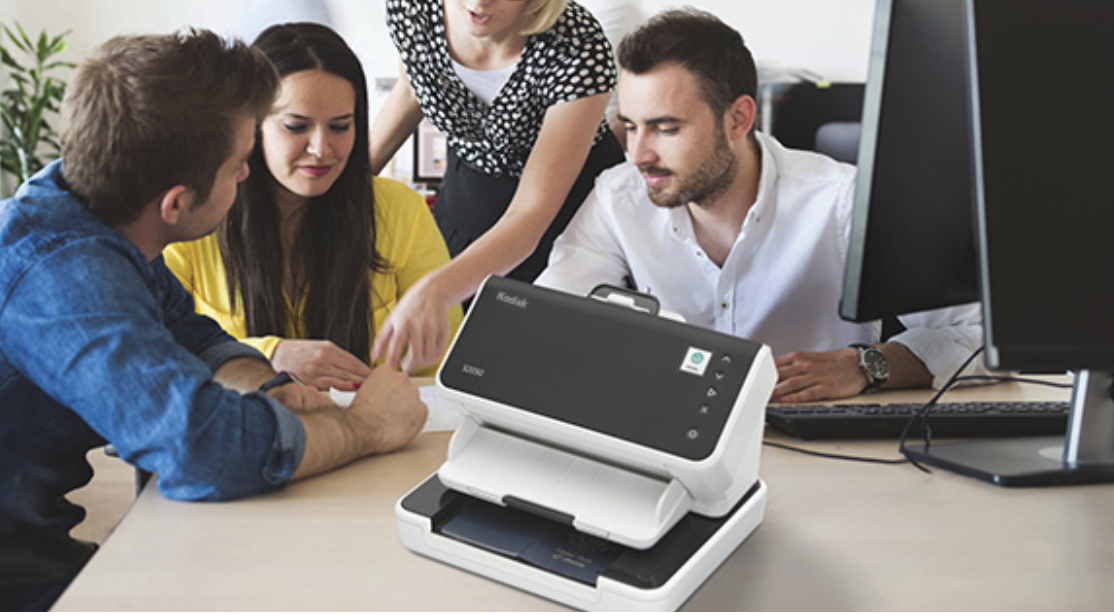
Michelle Ryder caught up with Robbie Trower, Sales Manager UK & Ireland, Benelux & Nordics at Kodak Alaris to find out more about the company’s long heritage as a dedicated scanner manufacturer.
Here’s an excerpt of the conversation





Michelle Ryder (MR): The company strapline is Kodak Alaris – where digital information starts. The DX journey starts with capture, and that’s where scanners come into play. Can you tell us about the range of scanners you offer?
Robbie Trower (RT): We’ve been making scanners for over 30 years now. We have a very broad range of scanner hardware – from entry-level basic desktop scanners all the way up to high volume production scanners. It’s actually the broadest range in the industry and we often say to partners, if your customers are looking for a scanner, we’re an incredibly safe and sensible place to be because with the broadest range, we’ve got a good chance of being able to satisfy their requirements.





In the industry, there are different sectors or types of classification when it comes to scanners such as desktop, workgroup, departmental, etc. We keep it a little bit simpler, we have what we call the distributed capture range of scanners and that’s effectively all of our A4 scanners which range from 20 pages per minute (ppm) up to 85 ppm with various features along the way. And above that we have production capture, which is effectively all of our A3 scanners., this we break down into low volume, mid volume and high volume so we’ve got all the bases covered.
MR: What do you think vendors need in order to survive in this competitive market?
RT: The scanner market is pretty competitive. You’re absolutely right. There are two parts to that – one will be around focus and the other will be around unique technologies.
So, what I mean by focus is that if you look at the top five scanner manufacturers in the marketplace, which includes us, obviously, we’re the only company on that list that’s a dedicated scanning capture company. We are completely focused on this one thing which is scanning and capture. I think that’s really key for people to understand.
The other side of the answer, I guess is around technology. There’s so much more to scanning documents than just getting an electronic copy of a physical piece of paper. If you look at the question, why do people buy scanners? It’s because they have important information within documents and they need that important information somewhere else. That’s actually why people buy scanners. It’s as simple as that. So that information is key, because the scan might be the beginning of a process, it might trigger a workflow or do something else, but it’s the information that’s key.
So, it’s about making sure that the image quality is as best as possible. All of our scanners have Perfect Page technology to make sure that people are getting the right level of quality from their images from day one and throughout the life of a scanner. But there are other unique things about our technology as well that differentiates us.
One would be metal detection for example. Some of our production scanners have metal detection, documents are quite often held together with staples or paper clips, and when the document gets particularly thick, there’s bits of string with bits of metal on the end. So, metal detection is really important, it allows us to prevent any damage to the documents as well as any damage to the scanner, which can be a substantial investment.
Another key one would be dual illumination, which is all part of making sure we get the greatest image quality and there’s also onboard image processing as well.
MR: You’ve described some of the unique features that scanners from Kodak Alaris have in terms of ensuring that the image captured is the best quality possible. Perhaps you could expand on onboard image processing, what is that and how does it work?
RT: Image processing is a really important part of scanning and that’s basically what our Perfect
Page technology does. A lot of the information contained in documents is going to be captured using OCR. We’ve got the image now we’re going to OCR to extract that information into the workflows. We want to make sure that the image quality is as good as possible because that will ensure that the OCR results are as good as possible. The better the image quality, the better your results. The better the OCR results, the more fluid the next part of the process is going to be. So, it’s really important to get that right at the very beginning, which is why image processing is so important.
Nearly all of our scanners have image processing on board, the scanner has a processing chip within the box that does that image processing. Competitors will do the image processing on the scanning PC or somewhere else and that’s fine. But let’s say for example, you’re in a reasonable volume environment. There’s lots of scanning going on. Maybe you’re scanning at say 150 pages a minute, something like that. Now, our onboard image processing that’s doing all of that is doing it on the scanner. It’s not having to do anything else. Its job is to process those images as fast or faster than the scanner is bringing the pages into the machine if you see what I mean.
If you’ve got image processing taking place on the PC, then the PC is having to do the job of enhancing the images and cleaning them up. But PCs have always got lots of other tasks that they’re doing in the background that we don’t always see. And if the PC doesn’t have the right level of power to keep up with processing 150 images per minute, it’s actually going to slow the whole process down. So, by having onboard image processing, we’re less reliant on that PC and we can guarantee the scanner continually runs at rated speed, it doesn’t have to keep slowing down because there’s a PC somewhere trying to enhance these images.
MR: How important is innovation is to Kodak Alaris and how do you remain relevant in an ever-changing market?
RT: The short answer to maintaining our relevance in this area is innovation. But also offering the whole picture of capture. So, yes, the scan piece is important when you’ve got to digitise physical documents. But that’s not the end of the story, as we were discussing previously. There’s another process after that.
We have software available as well that deals with classification and indexing and automating the process of getting key information from documents into the process or the destination that it needs to be in.
We also have our own service and support team at Kodak Alaris. They’re all Kodak people employed by Kodak and they are there to look after the people that have bought any of our products, whether that’s hardware or software, they’re there to support customers.
MR: Part of that team would be professional services; how does that team help partners provide their customers with a complete end to end solution?
RT: We’ve got the scanner hardware and capture software, but these things need to be configured, tailored, and set up for a customer. We work with our partners to determine those requirements upfront and then we can implement it.
Within our team we’ve got people that can manage that whole process this includes pre-sales engineers that can go out to customers and discuss their requirements. And from there, we can make recommendations put a scope together etc. and when the project goes ahead, we have project managers that liaise with our team, the department’s team, the end-users’ team, on the whole process from deployment, testing to go live.
We’ve got consultants that install and configure the scanners and software and if there’s anything outside of that we’ve also got software engineers and solution architects that can do more bespoke stuff where we’re tailoring it to very, very specific needs.

