
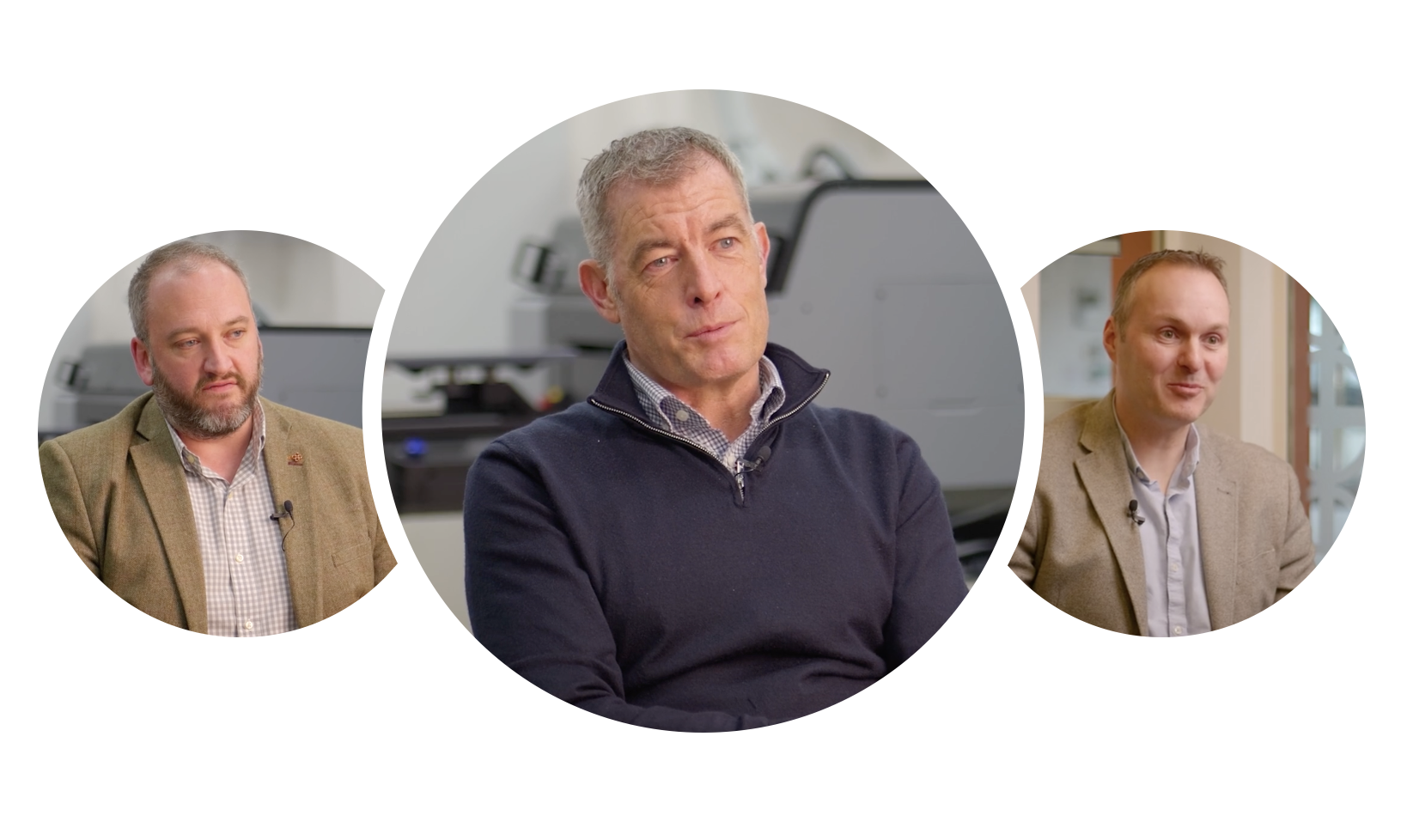
In an exclusive video series with Epson, Michelle Ryder explored how resellers are utilising decades of industry expertise to optimise the new balanced deployment of print, along with some of the key challenges facing both dealers and vendors, including the increasing accountability businesses are taking the environment



Read on for an excerpt of the conversations with XBM, Carbon, and Dectek
Richard Taylor, Managing Director, XBM





Richard Taylor, Managing Director, XBM said that the impact of the enormous shift in printing habits over the past few years as a result of hybrid working, has been less dramatic on XBM’s business. “We turnover around £7m, but the majority of our customer base is small businesses, and they had to go to work, as that was their only source of income. So, the work from home trend hasn’t really impacted them, in fact print volumes are back to where they were pre-COVID and indeed still growing.”
Commenting on the launch of Epson’s new AM-C400 and AM-C550 A4 MFPs, Taylor said: “We’re targeting to grow the business to £30m over the next eight years. As I said earlier, we serve a lot of owner-operator businesses, we typically install anything from one to ten devices, although we do have some larger fleets 25-30 machines. In terms of future growth, we know that we’re not going to hit our target simply by pedalling faster, you have to have bigger customers, more machines in the field, larger profits, and more opportunities to make more profits.
“So having the ability to go into a customer that historically would have bought 100 A3 devices due to the fact that they have the volume requirements, being able to say we can actually save you money by deploying 50 A3 and 50 A4 MFPs because the A4s can handle the same capacity as an A3. I think that’s massive and will add benefit to what we’re going to do as a business to help us grow. Not only that, but you’ve also got the Epson message around sustainability, which is the product we lead with.”
Balanced deployment
He continued: “Balanced deployment is not a new thing. It’s been around for years. I think balanced deployment on its own, won’t be a massive thing for us, but balanced deployment with Epson, will be, and the reason for that is because of the sustainability reports.
“We can go into a business and talk about print volumes, how many machines they have, how often they change toner, and how long does that take? Then what’s the hourly wage of the person doing that? Then we can input all of that information into a sustainability calculator, it takes five minutes, and produces a certified report. It even produces a certificate at the end that shows energy and carbon savings. This all adds to the benefit of balanced deployment because not only can you show them savings from a sustainability point of view, but we can also show it hopefully in the price overall, because the price of an A4 unit will be lower than an A3, but it has the exact same capability.
In terms of future growth, we know that we’re not going to hit our target simply by pedalling faster, you have to have bigger customers, more machines in the field, larger profits, and more opportunities to make more profits.
Consultative selling is the future
The conversation moved on to explore how selling has transformed into consulting as customers are looking for a trusted partner to enable them to deliver digital-first workflows and solve their pain points.
“Historically, salespeople would go out and talk about sheets, feeds, how fast the machine is how low they can take the click, the lease price, settlement price etc. that isn’t consultative
selling, it’s just basically going out asking a series of questions and then undercutting it. That isn’t adding any benefits to the customer whatsoever.
“With the help of Epson, we’ve educated our sales force how to sell without talking about a photocopier. So, my team are now going out into the field and selling based on sustainability, based on saving electricity, based on carbon offset. Sustainability is a massive buzzword. We talk about XBM going for bigger accounts and sustainability is even more key within those bigger accounts because they have to be seen to be doing something, so consultative selling is the future of this industry.
“Believe it or not, not talking about a photocopier is key to that. Talking about all these other things, these added benefits that they didn’t even realise that we could provide, they thought that we were just their print provider, we’re not, we’re also their sustainability officer, we can reduce their costs, staff costs, everything, with a photocopier, but by not talking about a photocopier,” Taylor concluded.
Ryan Green, Digital Services Director, Carbon
Ryan Green, Digital Services Director, Carbon spoke about some of the key challenges businesses are facing today. “We’ve seen a lot of changes over the past couple of years, the pandemic has seen a massive shift in the way people work. They’re no longer in the office five days a week, and what that’s driven is a need to be able to access information from anywhere, whether that’s at home, in a coffee shop, or in the office.
“Businesses need to become more efficient but with less people, and that’s encouraged us to look at how we can manage their print sustainably but also to look at how we can transform them digitally. So, looking at why they’re printing, what are they actually doing, if they need to print something, and how we can digitise and automate some of those processes. And that’s how we can build this whole sustainable ecosystem around our customers.”
Changes in the office environment
Commenting on changes within the office environment, Green said: “With people working from home and needing to print, security is a big issue. During the pandemic, a lot of people were scanning documents to their personal email addresses. How do you control that?
“We bring it together and control it so you can have an A4 device that someone can use at home to print and scan. But also, in the office, A3 volumes are starting to decline. So maybe before we position an A3 device, we will position an A4 device, but it needs to be able to cope with the volume, which is still there, although it may not be A3. Also, around that, we found that some people have a need for scanning, but they don’t actually have a need for print. So, we can look at the right balanced deployment around the whole office ethos,” he explained.
Sustainable technology vs. sustainable branding
Green went on to explore whether customers understand the difference between sustainable technology, for example, solutions that use less energy and reduce waste, and sustainable branding – carbon offsetting through tree planting for example.
He said that people are a lot more aware and want to change what they’re doing to make a difference. “So rather than the traditional things which are all good and work together as part of sustainable action, where customers may have planted trees to carbon offset, now they actually want to do something about the problem and make a positive impact, a positive change,”
he explained, adding: “Looking at how they can reduce energy, improve efficiencies and obviously work more environmentally-friendly, so it is becoming a big thing.”
A competitive edge
On the topic of heat-free technology, Green said that it aligns with everything Carbon is doing as a company, promoting sustainable print, digital transformation and automation using AI, everything to do with helping the environment, helping customers work more efficiently.
“It definitely gives us a competitive edge when we start talking about how much energy people can save, how much carbon they can save by reducing the energy and the footprint of printing devices – high yield ink tanks, fewer replaceable parts compared to laser – that all has an impact, as well as fewer delivery miles and courier costs for all those deliveries.
“What we always try to do is to look at what our customers are doing from a CSR point of view and align our proposals with their CSR strategies. So, we can provide the solution that not only helps them work more efficiently and more sustainably, but also aligns with what they’re trying to do and achieve as a company,” he concluded.
Declan Keogh, Service Director, Dectek
In this interview, Declan Keogh, Service Director at Dectek, reveals that cost, sustainability and reliability are the top three things, customers are concerned about today. As a case in point, he recalls the company’s first installation of an Epson device five years ago. “I met the customer recently in a restaurant and we spoke about how we put the machine in when he was under pressure. Five years in, there’s been just two service calls. So, for him, the reliability has been brilliant. The colour is excellent too, customers have complimented us on this.
“Reliability is a key selling point for us with Epson. Now we’ve seen the new products [AM-C400 and AM-C550] we know where they will sit. Some of the boxes have been too big, too cumbersome for where they need to go into, and I think the two new products will really sit in areas where we need a nice, neat fit in some offices,” he added.
Talk to the customer
In terms of deploying solutions, Keogh said it’s key to talk to the customer. “In some cases, you’re asking a customer who doesn’t have any IT knowledge, they just have buzzwords, so you’ve got to talk to them and their IT provider if they don’t have an in house IT person and figure out what they’re trying to achieve. Whether that’s scan to cloud, or work off the cloud, or to have machines that are literally able to do everything themselves.
“Now we find the Epson machines can report themselves offline, without the need for a server. A lot of customers don’t want servers in-house, mainly to reduce energy. They’re conscious about the environment, we listen to them, and we work with their IT companies to find the right solution.”
He continued: “For example, last week, I met a customer who wants to scan to SharePoint, they only moved to that in the last couple of months. And now they want to scan to SharePoint, that gives us an opportunity to sell them a product that works throughout the
fleet and will scan away for them all day long. We found with other customers that they can’t configure scan to email, they have no IT knowledge. Epson devices have scan to cloud built in, a feature they didn’t know about, we use it for them to enable them to scan. They love it.”
Built-in software
Keogh pointed out that for the last 20 years, the business has always been reactive – ‘my machine is broken, get to me now’. “But things have changed with the software built into machines, so we can remote look at machines, order ink etc. We have a lot of customers with company-owned printers in their houses. The machine will report to us, we can also get an alert if something is wrong, we can give them a call and ask them if there’s a problem or if they need a call out.”
In conclusion he said: “For as a company, going forward, we’re seeing our business changing to an inkjet business completely. We stopped selling laser about a year and a half ago. We enjoy the journey that we’re on. We’re seeing our customers embrace it. We’re being very open with customers; we’re saying look at what this machine will do for you and every time we go to market with an inkjet machine, a heat- free machine, which saves 87% of the power, that can be massive in a factory, smaller in a home office, our customers love it and we’re finding it works very, very well.”

