

Almost three quarters of print channel companies surveyed by Quocirca for its Channel Sustainability Study 2023, reported that they have some form of company sustainability strategy in place, with more than half stating that the dominant driver for channel sustainability initiatives is to meet customer expectations.





PrintIT Reseller: More than two-thirds (69%) of respondents to the Quocirca study said customers are showing strong or moderate interest in sustainable offerings, and 92% say that customers are prepared to pay more for solutions with stronger sustainability, at least some of the time. Has this been your experience, or with the cost of living crisis, is cost still king?
 Chris Bates, Business Unit Manager – Print and Supplies, UK, TD SYNNEX: The Quocirca findings are consistent with the feedback we’ve been getting from partners. End-user customers are asking more about sustainable options. Often, purchasing a more sustainable device can also help to reduce costs through a reduction in the need to replace ink cartridges and lower power consumption. We’ve certainly seen more interest in print devices with refillable ink tanks and improved energy efficiency.





Richard Wells, Head of Office Print Sales, Epson UK: It’ll be difficult to put ‘cost’ in the backseat, and since the recession it seems that everyone wants benefits around cost in addition to environmental, quality, and productivity to boot. The growing expectation from customers is that sustainability shouldn’t compromise anything else, and nor should it.
At first glance, this doesn’t always seem like a plausible option. If you’ve managed to cut waste or energy or pack more spec into a smaller device, surely something’s got to give way? To persevere the climate crisis, we can’t afford to offer sustainable benefits that compromise a customer’s profitability, otherwise we’re compromising their investment into their own sustainable development.
Epson is extremely aware of this, which is why for decades now it has made significant R&D and manufacturing investments into its inkjet offering. This has enabled today’s heat-free inkjet proposition – a smaller, more robust printing solution that consumes significantly less energy than laser technology, emits far fewer emissions, goes through fewer consumables, and requires less intervention. It doesn’t cost customers more and based on the increased staff efficiency and reduced energy consumption it’s bringing businesses; it’s actually saving them money.
 Ryan Mitchell, Print & AV Director, Westcoast: Yes and no. For many years on government tenders there has been an element of the scoring aligned to sustainability, but this was not a primary weighting, but recently it’s become a lot more important. If we look at the French government, they have stated that 20 per cent+ of all their IT must be second life.
A lot of the larger corporate tenders are very much looking for a ‘greener’ offering. Smaller SMB and SoHo customers still need their products to be cost-effective and sustainability takes a back seat. Many vendors offer a carbon offset token at a cost which gives some peace of mind. Lexmark addresses this by making machines that are built to last. Recently, we reviewed our own MIF and have a Lexmark printer that is over 12 years old and still works fantastically!
 Ian McIntyre, Director, PCL Direct: While we acknowledge the insights presented in the Quocirca Channel Sustainability Study, our experience differs somewhat from the survey findings. In our case, we have found that cost considerations continue to be of greater significance than sustainability for our dealers’ customers.
Fortunately, our products do tend to be affordable, as remanufacturing costs are between 20 to 30 per cent less than the production of OEM products, and we always strive to strike a balance between sustainability and costeffectiveness, aiming to provide the best value for our customers.
Our priority is to ensure that the solutions we offer are both environmentally conscious and economically viable. We have not received indications from any of our dealers that sustainability is more important than price. We would say that the current cost of living crisis has led our dealers and their customers to prioritise affordability above everything else. From a financial perspective choosing the remanufactured option benefits dealers. Since the pandemic, dealers have seen revenues reduce by around 30 to 40 per cent. As a result, they’re looking for innovative ways to build up their business again.

Louise Marshall, Director of ESG and Organisational Development, Brother UK: Sustainability is naturally becoming more important in business’ procurement habits, with it granted as much as 40 per cent of the weighting in some tender processes. However, customers don’t need to pay more to benefit from sustainable offerings.
In fact, greener options often create cost-efficiencies for companies to take advantage of. For example, managed print services enable businesses to tap into circular economies with their print infrastructure. Our MPS Essential plans start from as little as £5.78 per month and covers repair of devices, maximising their lifespan and reducing wastage. Customers can also return their toners to us free of charge to be remanufactured.
Gillian Anderson, Environment, Social & Governance Partner, Konica Minolta: We are certainly seeing an increasing demand for more energy efficient printers which address both environmental and economic considerations. Price is always going to be a major factor, but as a manufacturer it is our responsibility to ensure that every partner who sells and customer who uses our products are safe in the knowledge that every part of the supply chain, from manufacture, to packaging, storage and shipping has been optimised in line with our environmental, social and governance (ESG) commitments.
PrintIT Reseller: How are you helping partners to differentiate with sustainable products, solutions and services? Does your offering include remanufactured and/ or refurbished devices, recycling and take-back schemes or services that include sustainability impact reports?
Chris Bates: TD SYNNEX has a very effective trade-in programme and any devices that we take back are either refurbished or recycled through accredited providers. Being able to offer customers some kind of a value on their old equipment means partners can offer better value and more importantly, the customer can be sure that their old device won’t end up in landfill and will instead contribute to the circular economy.
Last year, we worked with specialist consultancy, Arete Zero Carbon to assess our own emissions and develop a plan to move towards net zero. We moved our Basingstoke offices to a more energy efficient location and 90 per cent of the electricity we consume in the UK is now from renewable sources.
We have achieved ISO 9001 (Quality) and ISO 14001 (Environmental Management System) across all four major UK sites, and we recently attained the Silver Medal from EcoVadis, putting us in the top 25 per cent of companies globally for ESG.
We have formed a consulting partnership with Arete to offer carbon impact assessment services out to partners and that’s sparked a lot of interest. We’ve also signed-up to the Meeting customers’ green aspirations.
Microsoft Partner Pledge and have run sessions on how partners can make their businesses more sustainable. In March, we launched a Sustainability Ecosystem to bring partners together to learn how they can reduce their carbon footprint and help their customers to move towards their own net zero goals.
In doing all this we are, we hope, setting a positive example for our partners and demonstrating how channel companies can meet their customers’ growing expectations with respect to sustainability.

Richard Wells: As outlined in UN SDG 17 and as recommended by industry, government and environmental bodies, partnerships are critical to pursuing environmental goals. From a print perspective, we’re removing any ambiguity about the sustainability benefits of our inkjet proposition and reinforcing it with measurable savings from the Optimisation Report.
This channel-based tool provides partners with a. comprehensive report on the calculated savings in energy, CO2 emissions, electricity costs, waste, time, and costs when switching from laser to heat-free inkjet printing. We also offer the CO2 and electricity calculator, which provides quick and easy measurements on environmental savings from Epson’s wider inkjet offering compared with laser.
In addition to manufacturing more environmentally conscious products, we’re also working first-hand with our partners to help them evangelise their customers on the importance of sustainable technology solutions. Afterall, you can lead a horse to water, but you can’t make it drink.
We have an in-house sustainability team, but ultimately need to rely on everyone to educate and advocate sustainability through the channel. As our sales proposition is pivoted around its sustainable differentiators, our workforce is increasing advocates of the environment and therefore able to contribute much more to the discussion with eco-minded end-user customers. This is the standard of service we strive to bring Epson’s MPS partners, and it’s the kind of support they increasingly need.
Ryan Mitchell: We have an in-house sustainability lead who will speak with partners to help them understand the new reforms, government emissions scope 1/2/3 and additionally how to wrap in an ESG conversation to a sales cycle. Our config and logistics services only work with partners that can provide a clear ESG message. For our client/PC business we are offering reconditioned and renewed products.
 Andrew Ellis, Director, PCL Direct: We work with 140 UK dealers and international distributors, with our products distributed in 32 countries worldwide. We actively encourage and support the channel in meeting their own sustainability goals by using only genuine OEM cartridges, which are remanufactured to OEM quality. We also supply a full range of remanufactured drums, developer units, fuser units and transfer belts across the Konica Minolta A4 to A3 MFP range, making them universally compatible with Konica Minolta, Develop, and Olivetti machines.
Many of our competitors import ready-made compatible products from the Far East, but we are proud to re-manufacture all of our products at our remanufacturing plant in Nuneaton, Warwickshire, which helps to support the UK economy and contribute to a greatly reduced carbon footprint. Within the PCL Direct group, we have established our own brand, Eco-Direct, which provides dealers with a range of re-engineered mid to high volume MFPs, which are upcycled from machines that are, typically, no more than three years old and print volumes preferably under 300,000 prints.
The introduction of Eco-Direct into the dealer channel has opened up more opportunities for dealers to meet their own environmental goals and make savings which can be passed on to their endusers. We purchase unwanted machines from the dealers which provides another revenue stream and keeps the circular economy in motion. It has been widely accepted and requests for products are increasing. Having now completed the refurbishment of just over 500 machines, we are planning to extend our range to remanufactured Ricoh and Canon machines in line with requests from dealers.
Our purpose is to offer the market a diverse selection of thoroughly tested, high quality eco-conscious MFPs and consumables at an affordable price, all backed by our interactive warranty service. We provide added value and options to the dealer channel. Our sustainable remanufacturing methods fulfil a crucial market demand, and we maintain our commitment by consistently delivering on our promises and excelling in our field.
Louise Marshall: Customers are increasingly scrutinising suppliers’ environmental impact. So, not only do firms want greener products, but they also expect vendors and resellers to operate more sustainably themselves. We’ve worked hard to achieve several accreditations, such as securing recognition from Valpak as being 100 per cent net zero waste to landfill across our operation at Brother UK.
We also want to make sure that we’re bringing partners along with us on the journey to net zero. Sustainability was a major focus of our latest Key Partner Conference at Red Bull F1 Racing’s HQ, highlighting how partners can engage customers and support their desire to go greener. Supporting partners with actionable insights is essential to our ethos, and we know that the strongest path to meeting net zero by 2050 is if we all take significant steps together, as one.
 Gillian Anderson: It is important that we share our ambitious sustainability targets with our partners, which is why earlier this year we made a public commitment to manufacture our products from more than 90 per cent circulated resources by 2050. We are also transparent in accompanying every Konica Minolta product with a detailed environmental datasheet and EcoLeaf environmental label.
Our printing devices offer features and settings to reduce paper and consumable consumption and we have given a great deal of thought to how to best package our products for transportation, reducing the packaging volume by 99 per cent. At Konica Minolta we are committed to contribute positively to our own environmental impact and that of our customers and partners.
PrintIT Reseller: While channel partners report that they are making progress with internal sustainability initiatives they need more help from print vendors to support customers’ environmental goals. What support do you provide for partners to help them win sustainability-focused deals?
Richard Wells: Epson is helping its partners by investing millions into making more compact, heat-free inkjet printing solutions that enjoy ultrahigh- yield inks and require minimal intervention compared with the legacy laser alternatives. We’re also working with our partners to prove the sustainability benefits (and cost, and time) of inkjet over laser using the Optimisation Report.
To this end, more and more businesses are reducing their energy consumption, CO2 emissions, waste, and service intervention thanks to heat-free inkjet, which has fast become the sustainable differentiator in the copier market. To make the switch from laser to inkjet more accessible in the home and small office market, we are running a laser trade-in campaign so businesses can get cashback on their inkjet when they return their laser printer.
And to adopt a more circular economy in office print, we will introduce second life extended warranties to give a longer lifecycle to our business printers, and we’re offering a free extended warranty on selected cartridge-free EcoTank printers for five years. From a manufacturing perspective, we’re seeing more recycled material used in the manufacturing of Epson printers.
We’re also innovating our proprietary dry-fibre technology in collaboration with third parties to standardise the production of biomass plastics, recycled from paper, which we aim to have in mass production by 2030. The same dry-fibre technology is also being used in the development of recycled packaging and cushioning materials for Epson products, again, based on recycled paper.
In addition to Epson’s investments into heat-free inkjet over the decades, we’ve also committed to spending 100 billion JPY by 2030 (around £540m) on decarbonisation, resource recycling, and environmental technology development. And to help educate and inspire partners on all our environmental and social pursuits, we are publishing all of this in our annual European Sustainability Report.
Ryan Mitchell: For hardware, we are trying to improve our current offering of recycled products and refurbished products. For certain products this works, but for print it’s more difficult, the secondary value is very low, and we need to consider that the logistics required to do this are costly and potentially reverses the good from the carbon offset.
Remanufactured ink and toner also create challenges, the vendors have invested heavily in the R&D of their products, some of which is used to support a circular economy, removing their ability to sell in new products will impact this. One of the best impact reports I have seen and used is Epson’s, when used as a sales tool it’s extremely strong and compelling. By far the best I’ve seen!
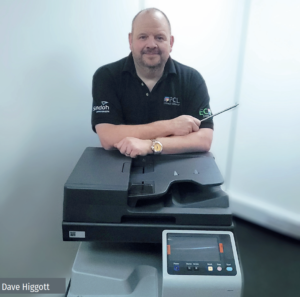 Dave Higgott, Technical & R&D Director, PCL Direct: PCL Direct is dedicated to integrating the principles of the circular economy into our remanufactured product lines and this is reflected in the way we reintroduce products into the industry, minimise waste and reduce the impact on the environment by giving a new lease of life to used and discontinued models and consumables.
One of the services we provide the channel is a collection service for used toner cartridges, parts, and machines. We provide the dealer with a waste collection certificate, as evidence that materials are being responsibly managed in line with WEEE directives. Once collected, the used cartridges are professionally cleaned and remanufactured.
We follow a strict procedure of multiple checks and live testing on all products and batch tests chips,toner and component parts. All our remanufactured toner products are tracked throughout the process and are recorded and tested every time new raw materials arrive, allowing full track and trace, and verification should any issues occur, or if warranty claims are made. Last year, PCL Direct sold over 100,000 toners and 60,000 drums with a failure rate below 1 per cent. We provide an extensive 12-month warranty for dealers through our online Warranty Portal to give added peace of mind.
Louise Marshall: Remanufacturing consumable products is a huge way in which we as an industry can cut waste and emissions. In August this year we became the first company to be awarded the Blue Angel certification for a remanufactured toner. This recognition came after the independent auditors found that more than 75 per cent of our TN-3512 RE toner’s weight consisted of re-used parts.
Our recycling and environment technology centre in Ruabon, North Wales, is one of our two main global remanufacturing hubs. The facility was certified as carbon neutral in 2021 and made a major contribution to Brother’s global milestone in recycling 40 million toner cartridges to date.
Remanufacturing cartridges in the way we do is saving approximately 5,300 tonnes of CO2 globally every year, which is equivalent to taking 1,150 cars off the road. Businesses with our MPS Enterprise offering, targeted at larger organisations, can also benefit from clear reporting on how much CO2 they’ve saved by sending their consumables back to us to be recycled or remanufactured. This provides them with insights for their own ESG reporting.
Gillian Anderson: Our commitment to the circular economy means producing world-class technology that is built to last. It is a philosophy shared by our partners, such as Agilico, with whom we have collaborated to create the National Refurbishment Centre in Leicester, which is breathing new life into ex-showroom and low utilisation machines. We are also providing our partners with tools that help their customers gain insight into how their devices are being utilised and where improvements can be made to minimise material wastage, reduce energy consumption and lower costs. And, when consumables are discarded, Konica Minolta will collect and recycle them as part of our World on Loan programme.
https://uk.tdsynnex.com/
www.epson.co.uk
www.westcoast.co.uk
www.pcl-direct.com
www.brother.co.uk
www.konicaminolta.co.uk
